Subterranean termites cause significant structural loss across Greenville County due to prevailing warm soil conditions and annual rainfall exceeding 47 inches. Targeted termite defense stops subterranean workers…
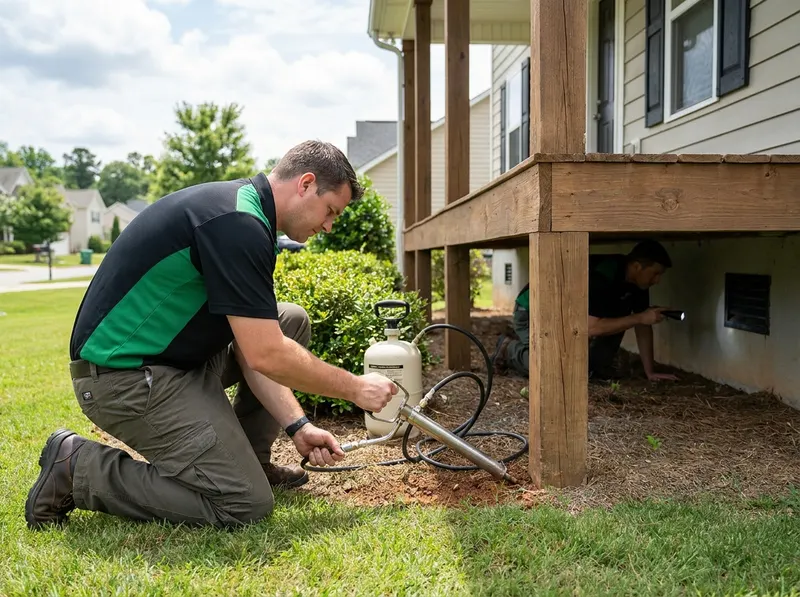
Subterranean termites cause significant structural loss across Greenville County due to prevailing warm soil conditions and annual rainfall exceeding 47 inches. Targeted termite defense stops subterranean workers before structural timber framing compromises home integrity. In neighborhoods like North Main and Alta Vista, crawl space foundations, stone foundation walls, and historic heart-pine floor joists demand precise liquid injections at critical soil-to-wood contact points rather than indiscriminate sprays. Properties in Gower Estates, Overbrook, and Parkins Mill frequently feature concrete slab interfaces, where workers enter through utility penetrations or expansion joints as thin as 0.8 millimeters. RavenCrest Insect Control applies non-repellent termiticides formulated under EPA pesticide programs, allowing foraging insects to unwittingly transfer active ingredients throughout the subterranean network back to the reproductive queen.
Selecting localized non-repellent soil barriers over broadcast fumigation eliminates unnecessary evacuation periods for families and household pets while providing decisive perimeter defense. For homes situated near damp topography such as Cleveland Park, the Reedy River corridor, or mature hardwood canopies in Botany Woods, high ambient moisture accelerates foraging activity. Ground-level termite monitoring follows protocols established by the Clemson University Department of Pesticide Regulation, enforcing safe application standards designed to protect regional watersheds. Foundation trenches are excavated 6 inches wide by 6 inches deep along exterior brick or masonry piers, treated with non-repellent active agents, and backfilled to create an unbroken defensive band.
Property owners choose between targeted continuous liquid barriers and low-profile monitoring stations based on foundation design. Liquid applications suit monolithic slabs and crawl spaces by establishing an immediate treated perimeter that lasts up to 10 years, whereas bait stations provide continuous subterranean tracking along sloped acreage near Paris Mountain State Park or expansive lawns in Verdae. The mechanical trade-off rests between upfront perimeter soil excavation and periodic station monitoring intervals. Structural wood members are visually inspected in accordance with standards documented by the USDA Forest Service Forest Products Laboratory, verifying crawl space moisture percentages below 19 percent to halt secondary wood-decay fungi.
Execution follows a disciplined four-stage containment process: Step 1 involves an architectural foundation audit mapping shelter tubes along masonry surfaces. Step 2 requires localized trenching around exterior perimeters and critical piers. Step 3 applies precise termiticide injections to sub-slab plumbing entries and voids. Step 4 concludes with exterior bait station placement spaced at 10-foot to 20-foot intervals to track secondary subterranean populations.
Every job gets a firm, written price after an on-site visit.
Tell us about your targeted termite defense job in Greenville and we'll send a clear, written quote, usually the same day.
 RavenCrest Insect Control