Stinging insect pressure across Upstate South Carolina peaks from late spring through early autumn, driven by the humid subtropical climate of the Piedmont region. Colonies established by queens emerging from winter…
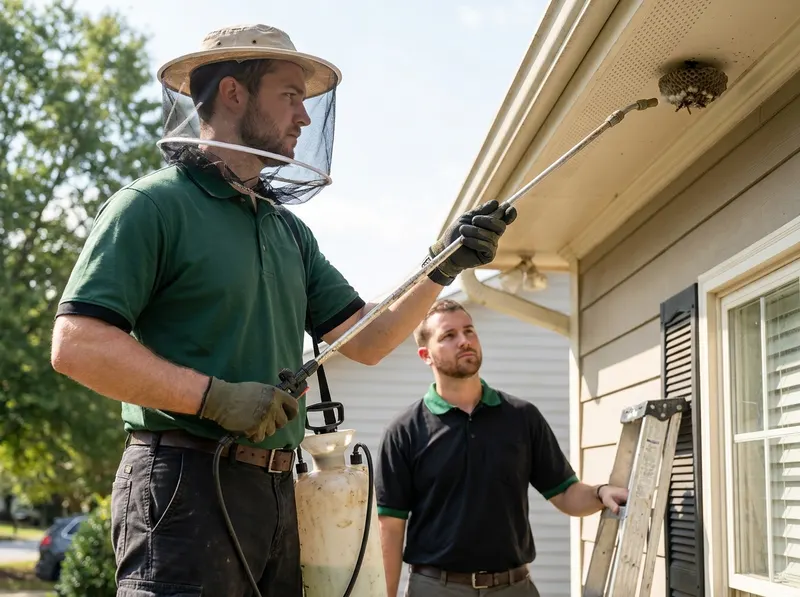
Stinging insect pressure across Upstate South Carolina peaks from late spring through early autumn, driven by the humid subtropical climate of the Piedmont region. Colonies established by queens emerging from winter dormancy quickly expand within residential architecture. In mature Greenville neighborhoods like Alta Vista, North Main, and Augusta Road, historic heart-pine eaves, porch ceilings, and lath-and-plaster wall cavities provide primary harborage for European hornets and subterranean yellow jackets. In newer developments throughout Verdae and Parkins Mill, unsealed brick weep screeds and soffit returns allow worker wasps easy ingress into attic insulation, where nests operate undetected until vibrations alert property occupants.
Eradication differs fundamentally from routine pest control sprays. Surface applications fail against entrenched colonies because queen chambers are protected deep within void geometry. Effective elimination combines precision micro-aerosol injections into entry conduits followed by targeted dust applications, in accordance with EPA pesticide regulations. This stops circulation within the nest rather than dispersing aggressive defenders across the yard. Technicians systematically map colony pathways using thermal imaging to confirm structural boundaries. Rather than carpet-bombing structures with volatile chemicals, technicians isolate the biological source to maintain healthy indoor spaces, complying with structural safety guidance from the Clemson University Cooperative Extension.
The primary trade-off between physical removal and chemical void stabilization centers on wall-void access. When yellow jackets nest inside finished drywall in homes near Cleveland Park or Overbrook, direct physical removal requires cutting finished gypsum wallboard, which demands immediate structural patching. By comparison, specialized pyrethroid or biological dusts injected through a quarter-inch test portal eliminate the nest entirely within 24 hours while keeping internal drywall intact. Property owners avoid repair costs while achieving complete nest mortality. All perimeter residual materials align with safety standards outlined by the Occupational Safety and Health Administration and pest management best practices from the National Pest Management Association.
Outdoor recreation corridors such as the Prisma Health Swamp Rabbit Trail and dense hardwood canopies around Paris Mountain State Park foster high wild stinging insect populations that frequently colonize adjacent residential fence lines and outbuildings in Botany Woods and Gower Estates. Unmanaged carpenter bee activity strips exterior trim boards and weakens cedar pergola joints across the West End. Specialized wood-injection techniques stop boring larvae, preventing woodpecker damage. Homeowners who avoid broad-spectrum perimeter spraying support pollinator populations, as outlined by the U.S. Fish and Wildlife Service, while relying on localized treatments to manage direct biological threats around their foundations. Treatment plans adhere strictly to South Carolina Department of Agriculture licensing requirements, clean water mandates monitored by the South Carolina Department of Health and Environmental Control, housing codes from the U.S. Department of Housing and Urban Development, and ecological standards from the Entomological Society of America. Call (864) 215-5119 for service coordination.
Every job gets a firm, written price after an on-site visit.
Tell us about your stinging insect eradication job in Greenville and we'll send a clear, written quote, usually the same day.
 RavenCrest Insect Control