RavenCrest Insect ControlRavenCrest Insect Control

Bed Bug Thermal and Contact Removals Greenville

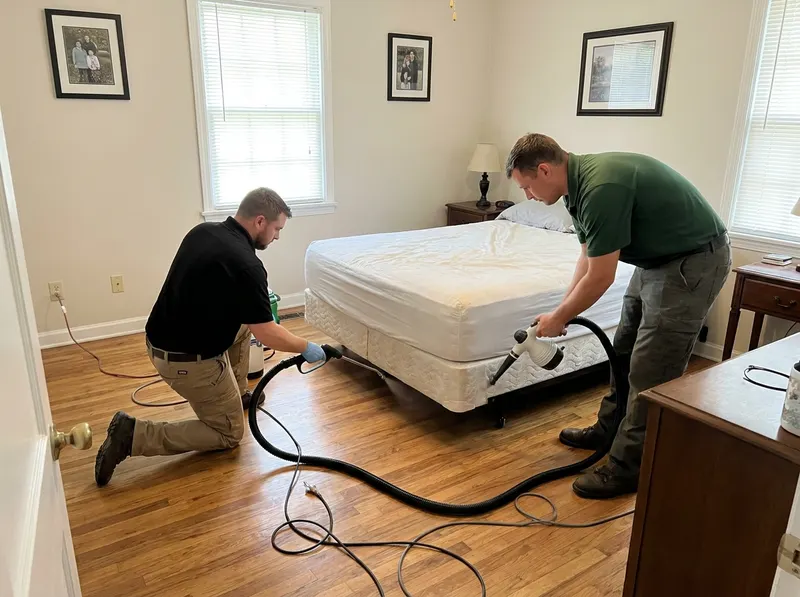
Structural bed bug eradication requires thermodynamic control rather than cosmetic aerosol discharges. According to the U.S. Environmental Protection Agency , effective pest management integrates physical controls with…
Get My Estimate →(864) 215-5119
Bed Bug Thermal and Contact Removals in Greenville, SC
Quick answer
  • Thermal heating zones raised to 122, 135°F paired with targeted residual applications along baseboards and structural voids.
  • Single-day treatment turnaround spanning 4 to 8 hours depending on square footage and structural layout.
  • Ballpark pricing begins at the $150 minimum diagnostic fee, with localized treatments averaging $450 to $1,200 and whole-home thermal projects ranging from $1,500 to $3,500+.
  • Eradicates adult bed bugs, nymphs, and eggs hidden behind trim, mattress seams, electrical plates, and floorboards.
  • Confirmed on-site inspection and preparation checklist verification prior to initiating thermal convection heaters.

Structural bed bug eradication requires thermodynamic control rather than cosmetic aerosol discharges. According to the U.S. Environmental Protection Agency, effective pest management integrates physical controls with measured contact applications. In historic neighborhoods like Alta Vista, North Main, and Overbrook, vintage tongue-and-groove flooring and plaster walls present deep harborages where insects retreat away from daylight. Structural thermal units direct continuous high-temperature air throughout the room envelope, forcing heat past insulation layers to reach the core thermal death point defined by the Journal of Medical Entomology. The Centers for Disease Control and Prevention notes that while bed bugs do not transmit disease, their bites induce severe sleep disruption, secondary infections from scratching, and psychological distress. Placing calibrated sensors across interior walls guarantees lethal exposure without compromising structural framing or personal belongings.

Material preparation dictates the remediation outcome across Greenville County homes, from brick ranch layouts in Gower Estates and Botany Woods to newer residences near Verdae and Parkins Mill. Homeowners prepare by staging clutter, laundering linens at high temperatures according to the Federal Trade Commission textile guidelines, and relocating heat-sensitive plastics or electronics. The process follows a five-step containment framework:

  1. Step 1: Visual mapping and canine or acoustic inspection confirm localized aggregation zones around bed frames, baseboards, and subfloors.
  2. Step 2: Technicians seal HVAC duct registers, entry thresholds, and window casements using thermal poly barrier sheeting to prevent perimeter heat loss.
  3. Step 3: Industrial convection heaters raise ambient air temperatures to 122, 135°F while high-velocity air movers circulate heat continuously through structural voids.
  4. Step 4: Technicians apply non-repellent contact desiccant dusts, evaluated under National Institute of Standards and Technology structural safety guidelines, behind switch plates and crown moldings.
  5. Step 5: Cooldown sensors log thermal stabilization, followed by a post-treatment structural audit to confirm zero insect movement before re-entry.

Choosing between localized contact treatments and full-envelope thermal remediation involves structural layout and infestation density. Single-room contact treatments target isolated frame harborages in modern single-family dwellings, preserving budgets when migration has not crossed interior wall cavities. Whole-structure thermal treatment is indicated for multi-story floorplans near Augusta Road or dense housing blocks in the West End, where radiant heating penetrates subfloors, ceiling joists, and shared wall chases. While thermal interventions require residents to vacate during the active 6-hour heating window, they eliminate the need for multi-week chemical retreatments. Structural protocols adhere to standard residential occupancy safety limits outlined by the Occupational Safety and Health Administration and pest guidance from Clemson University Cooperative Extension. For homes near Cleveland Park or the Prisma Health Swamp Rabbit Trail corridor, contact RavenCrest Insect Control at (864) 215-5119 for a comprehensive architectural assessment.

How much does Bed Bug Thermal and Contact Removals cost in Greenville?

Initial Bed Bug Inspection & Site Diagnostic$150 minimum
Single Room Targeted Contact Treatment$450, $750
Multi-Room Contact & Perimeter Dust Application$800, $1,400
Whole-Home Structural Thermal Remediation (Up to 2,000 sq ft)$1,800, $2,800
Large Estate Thermal Remediation (2,000+ sq ft)$2,800, $4,500+

Every job gets a firm, written price after an on-site visit.

Common questions

What preparation is required before a bed bug thermal treatment in Greenville?
Homeowners must remove wax items, pressurized aerosol cans, medications, and sensitive electronics, while laundering clothing at temperatures above 120°F in line with manufacturer care tags before thermal units activate.
How long do occupants need to leave their Greenville home during thermal bed bug removal?
Occupants and pets must vacate the structure for 6 to 8 hours while industrial heaters reach 122°F to 135°F and interior air cools back to baseline room temperatures.
Are contact treatments safe for children and pets in Greenville residences?
Contact treatments use targeted botanical, non-repellent liquid, or desiccant applications placed strictly inside enclosed wall voids and structural cracks where household occupants cannot touch them.
Why do bed bug infestations persist in older Greenville neighborhoods like North Main and Alta Vista?
Older homes feature deep architectural gaps, unsealed subfloors, and hollow baseboards that allow bed bugs to bypass standard surface sprays and nest deep within structural cavities.
How is the final cost of bed bug eradication determined for a Greenville property?
Exact costs depend on verified square footage, furniture density, degree of insect migration, and whether containment requires localized contact applications or complete thermal heating, with prices confirmed on-site before work begins.

Get started today

Tell us about your bed bug thermal and contact removals job in Greenville and we'll send a clear, written quote, usually the same day.

Get your PEST CONTROL SEVICE quote, Greenville

We only use your ZIP to check availability, no spam.